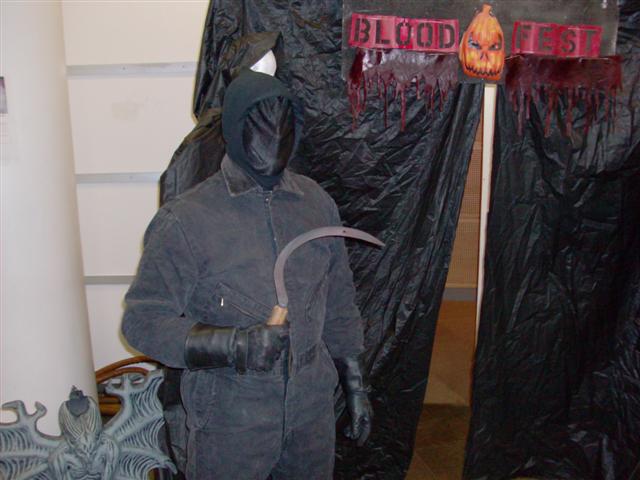
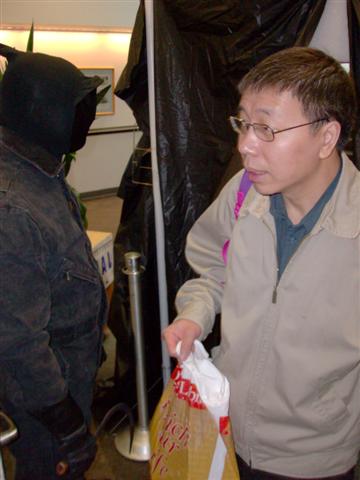
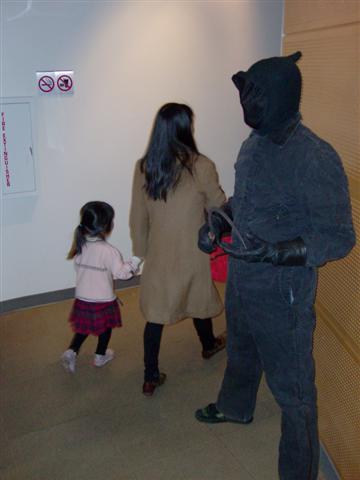
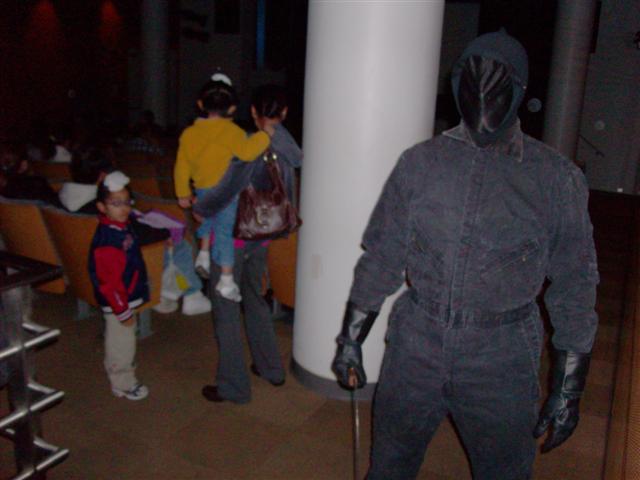
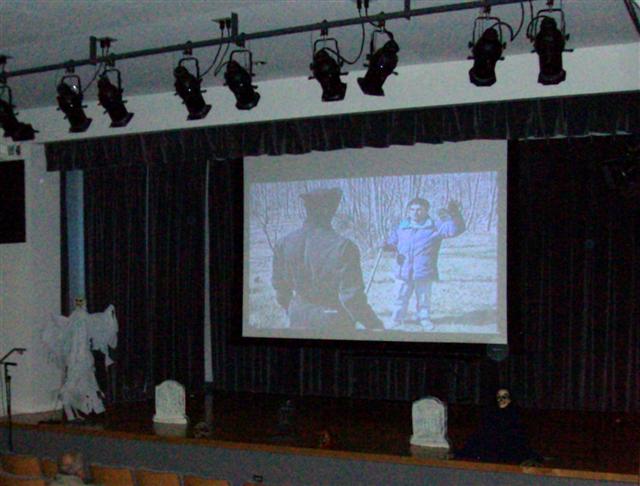
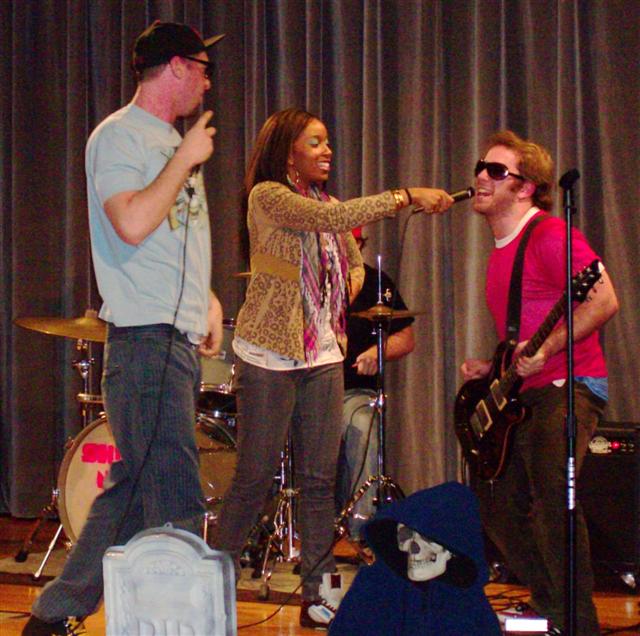
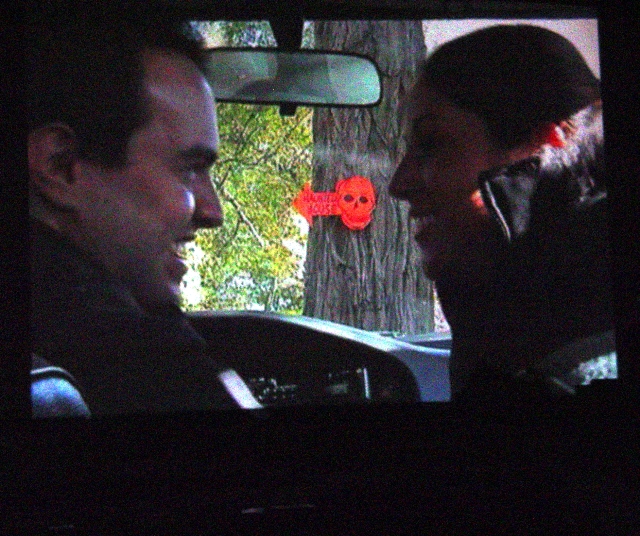
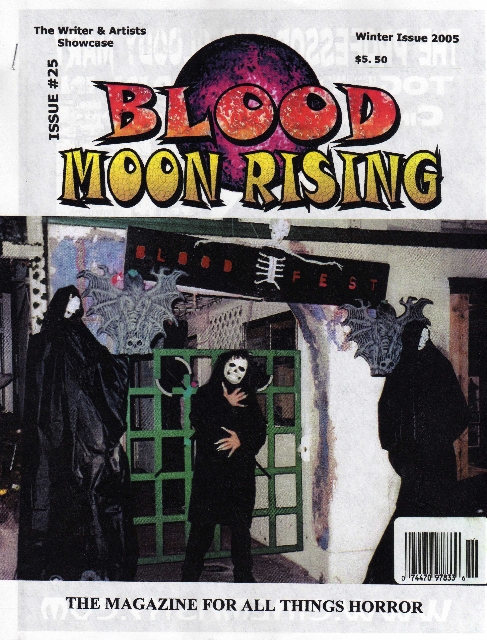
This is one of the short films showcasing at this years “Blood Fest: Horror Show
& Rock Party” and though it is very short its packs a bloody punch. The films
stars Mike Lane and cute as a button Nicole Berlingeri playing young lovers
looking for a fun new forbidden place to do the dirty deed. She tells her
boyfriend “Hey lets go in there”. Never a good idea and off they go. The place
is a closed down Halloween spook house complete with all the ghost, monsters and
axe killers it can hold. Well you guessed it, things go a little bad for them
and just before they get to do it too.
From out of nowhere the killer emerges and well you know the story from here.
..... But wait it's still not over and the killer himself falls prey to the
evils that lurk within the walls of this spook house.
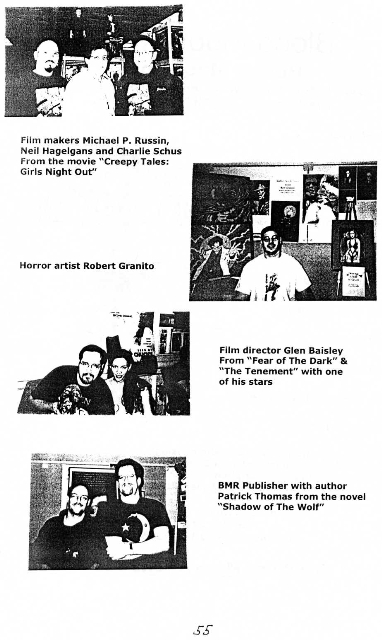
Light & Dark Productions who gave us horror fans such great indy hits like “Fear
of The Dark” and “The Tenement” now comes this short film with bite. Director
Glen Baisley is at his best here as he even slips his “Fear of The Dark” maniac,
The Black Rose Kille,r into the mix for fun. Even the co-editor of Fangoria
magazine makes it in as a zombie. The make-up was done by Brian Spears who like
Baisley has been interviewed in BMRs past issues hits the mark with some great
creature and blood effects.
Just the stage sets of skulls and other creepy goodies in this house of horrors
makes the film flow as you watch the two would-be victims walked about unknowing
their soon to be bloody fate. This film will make you think twice before the
next time you go to a haunted house and never ever do it when its closed.
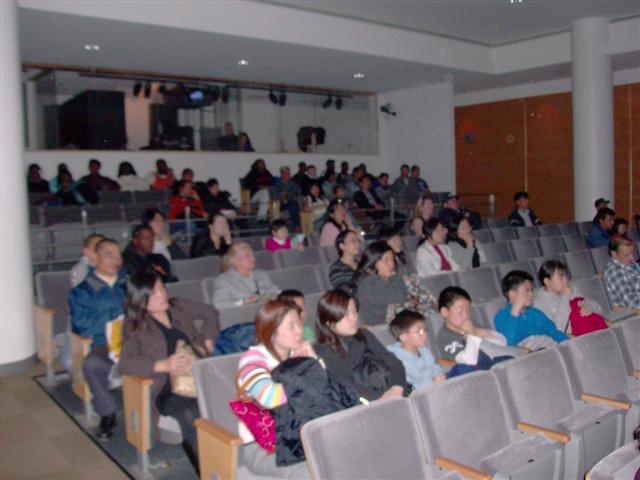
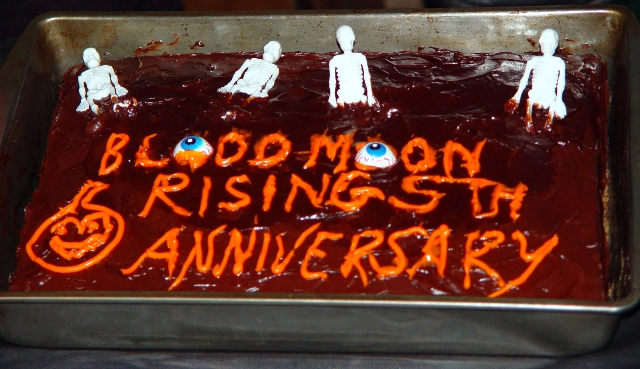
Blood Moon Rising's 5th Anniversary Film Festival &
Halloween Bash
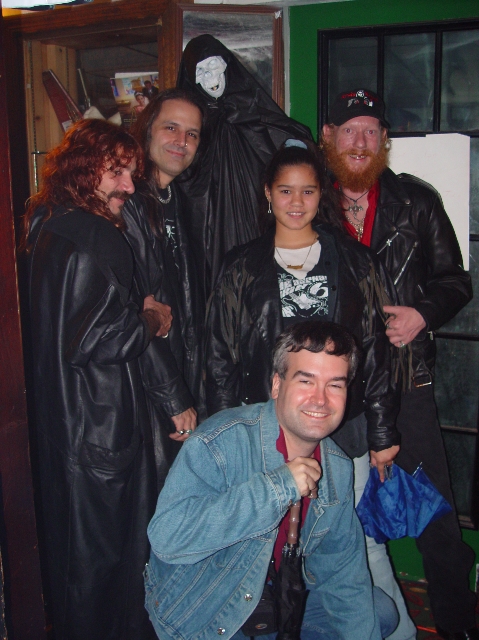
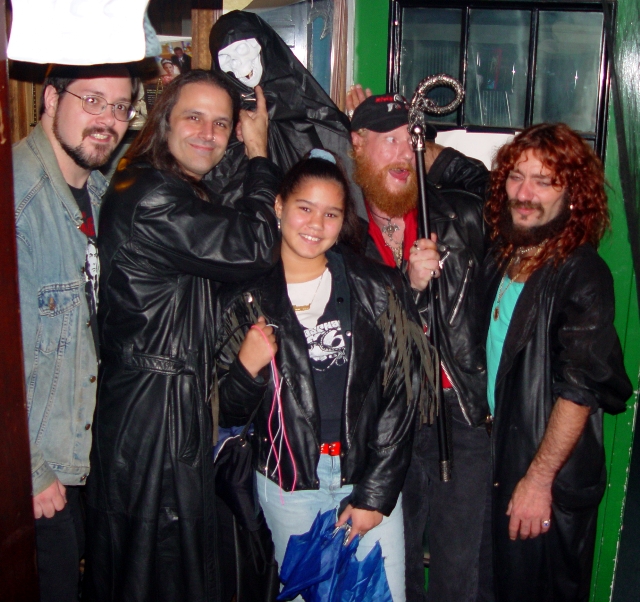
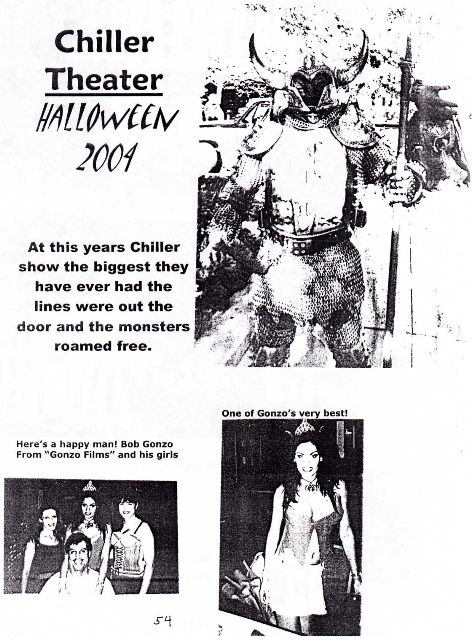
Cast and friends joined Blood Moon Rising's 5th
Anniversary
celebration and attended the Blood Fest 2005 showing of
No
Trespassing 2: No Exit. It took place on October 8, 2005
which marked
the one year anniversary since No Trespassing 2
wrapped.
This is a short film brought to you by Light and Dark Productions, the same
people
who brought you The Tenement. Now they give you a quickie in the style of the
Twilight Zone.
The short begins with a young couple looking for something to do. They chose to
go to the local
haunted house to look around and find some thrills. What happens is that they
get a lot more than
what they bargained for.
For a short film, they do a decent job setting the mood and it tells a standard
story. What happens
right after is a nice twist and gives a new meaning to justice. If you are
interested in this or any
other movies they do, visit their website www.lightanddark.net.
An Interview with FANGORIA Managing Editor,
Michael Gingold and Special Make-up Effects Artist,
Brian Spears
By Glen Baisley
Having finished
shooting my fourth feature length movie (FAIRVIEW FALLS) this past summer, it
was
time to take a break. But, it wasn’t the case for two good friends and
colleagues of mine who
helped me out all summer long. For them, their work was
just beginning. Fangoria managing editor,
Michael Gingold was called upon to
rewrite (from the ground up) the screenplay for Media Blasters’
latest horror
movie, SHADOW: DEAD RIOT. And, after having won “2003 Best Make-up Effects” for
FLESH FOR THE BEAST, Media Blasters asked Brian Spears and his partner, Pete Gerner (G & S Effects)
back to helm the effects along side Canadian FX artist,
Allan Cooke.
The movie wrapped in
mid October. Recently, I had a chance to sit down and discuss the movie with
Mike and Brian and in the course of doing so learned a little bit more about
their inspirations, hopes
and dreams.
Michael Gingold Interview:
GB: What was your first
writing job and how did it lead to your involvement with FANGORIA Magazine?
MG: I’m dating myself
here, but my first-ever writing about horror was a review of PHANTASM that I
wrote for my junior high-school newspaper. I wrote movie reviews for my
high-school paper as well,
but I was still seeking an outlet to communicate with
other people interested in horror—this was long before the Internet, and in my
small high school there weren’t too many die-hard horror fans.
Then a friend
who had placed a free subscriber ad in FANGORIA got sent a copy of a fanzine
called
CONFESSIONS OF A TRASH FIEND. At that point, I assumed that fanzines
were all the size of
regular magazines, if not as polished, and here was a
Xeroxed newsletter that was simply one guy
sharing his thoughts on the
exploitation films of the past month. I was immediately inspired and
started my
own photocopied ‘zine, SCAREAPHANALIA, which lasted nearly a decade.
I met the various
FANGORIA editors at conventions and screenings over the years, and while at
college I went in to interview for an internship there [in 1988]. Tony Timpone
knew about
SCAREPHANALIA and I showed him some samples of my work in a college
paper as well. After I got
back to my dorm, it was only a few hours before he
called me back—to offer me not the internship,
but a job writing an article for
the magazine. It was probably the hardest article I’ve ever written
for the mag,
by the way—an interview with THE SEVENTH SIGN director Carl Schultz, who spent
our
whole talk insisting, “It’s not a horror film.” I barely managed to get a
three-page article out of it,
but I guess Tony liked it because I started
writing for Fango regularly, and quickly moved up to
associate editor and then
managing editor.
GB: Having written
LEECHES!, RING OF DARKNESS and most recently SHADOW, what’s it like seeing
your
stories become celluloid?
MG: After having made a
number of short films and shooting a Super-8 feature that never found its
way to
completion, sitting down to watch LEECHES!, the first thing I’ve written that I
didn’t direct,
was a little nerve-wracking. I was happy to see that much of my
script remained intact, and Dave
DeCoteau made it look pretty damn good despite
severe budget and time restrictions. I was most
pleased to see that my two
favorite scenes (the “eat the leech” bit and the dream sequence with a
comic punchline) came out pretty much exactly as I had envisioned them. I’ve learned
well through
talking with and getting to know a number of screenwriters that
once the script leaves your hands,
any number of factors can affect how it plays
on screen. Most significantly, the script can be
severely changed, but even if they stay true to your words, the director can emphasize the wrong
things, or
the wrong actors/actresses can be cast—I’ve seen it happen more than a few
times, and
learned long ago that what might play on screen like “a bad script”
isn’t necessarily the fault of the
screenwriter. Of course, sometimes it IS,
too—I’m not trying to absolve us scripters of all the blame!
In the case of SHADOW, I’ve only
seen raw footage and a promo reel, and it looks pretty damn good.
When I found
out that the movie was going to be directed, photographed and
fight-choreographed
by Hong Kong filmmakers who have worked with Jet Li and
Jackie Chan, I knew the script was going
to be in very good hands. I can’t wait
to see how the finished movie turns out.
GB:
What was the experience like on the set of SHADOW?
MG: It was interesting—I
wasn’t there so much as the writer involved, but to play a zombie cameo. One of
the scenes I was involved with was handled by the second-unit team, and I don’t
even know that they were aware I was the writer. It was cool to work with
makeup FX artists Brian Spears and Pete Gerner, who had done the honors for me
on THE TENEMENT, and also Canadian artist Allen Cooke, who brought some zombie
appliances generated from molds used on the DAWN OF THE DEAD remake, which I
wore. I got to “eat” fake guts, charge down a hallway and wrestle with one of
the actresses—what more could I ask for? It was also fun meeting the actors and
actresses, who all seemed perfect for their roles. I got to hear some of my
dialogue delivered on set, which is always a thrill.
But one of the
things that most impressed me was the location. SHADOW is a zombie/martial arts
film set in a women’s prison, and it was shot at a real disused penitentiary
that’s hosted other
movie shoots in the past. The place really is a horror film
waiting to happen: shadowy hallways,
claustrophobic cells, peeling paint
everywhere. Oh yeah, and at one point the still photographer
grabbed me, FX
artist Gene Mazza and another of the extras (all in ghoul makeup), and took us
down one hall to shoot some promo photos. So there’s a chance that at least one
of us is going to
show up on the movie’s sales flyers and/or DVD packaging!
GB: What are some of the
creative challenges writing screenplays for others?
MG: Obviously the biggest
is simply the fact that you’re writing for someone else’s vision and don’t
have
final creative say. The trick is to get a good sense early on of what the
filmmakers want and
do your best work within those parameters, and contribute
your own personal touches within those
guidelines. Some filmmakers, like Dave,
are clear on what they want, and it also helped that I was
familiar with his
type of movie when I first got the LEECHES! job. On the other hand, I once
worked
for a producer who didn’t seem to know what he wanted and only gave me
the most general of
notes, so I simply had to give him what I thought he wanted
and, once again, do the best I could
with it.
Also, if you’re
writing for people in the independent/low-budget world, you have to be prepared
to
scale down your imagination. You might come up with an idea that both you
and the filmmaker(s)
love, but which simply can’t be achieved with the available
money. Similarly, when financing is
tight, you often have to write to a certain
page length and not go over. That’s where I’ve found my
magazine editing
experience has come in handy; over my years at Fango, I’ve developed an ability
to
pare down an article by trimming lines here and there instead of lopping out
whole paragraphs, and
the same skill comes in handy when shortening scenes in a
script as opposed to taking complete
scenes out.For the Light & Dark
movies that you have appeared in, particularly The Tenement, you
have had
creative freedom to write some of your own dialogue. You also had a lead role
in The
Tenement as the nefarious director Winston Korman. What was that
experience like?
Well, it wasn’t much
fun getting whacked repeatedly with a “fake” but pretty solid shovel, and then
having to go back and do the scene again to capture the sound FX when the audio
on the previous
takes proved unusable (ever hear of foley, Glen?). But
seriously, the experience was a lot of fun,
especially the chance to come up
with some of Winston Korman’s rants. The cool thing about this,
and my previous
scene in FEAR OF THE DARK, is that Glen didn’t insist on knowing what I was
going
to say in advance; he just turned on the camera and let me roll. I didn’t
really improv right on set; I
knew beforehand what I was going to say, and in
fact the “puppies” line in TENEMENT was something
I had thought of some time
before, and had been looking for a chance to use ever since. Korman
was the
first time I’d had a significant role in a movie instead of just a cameo, and
playing a
complete bastard was freeing, in the sense that based on the script, I
knew there was no way I
could be too extreme with the character. I was just
hoping I didn’t let Glen down; I’ve never really
considered myself an actor and
I do these roles just for fun and to work with filmmakers I like, and
this time
I was playing a fairly crucial role. But Glen was happy with my work (right?),
and most of
the reviewers have seemed to enjoy Korman’s over-the-top-ness.
In addition, it was
fun and interesting going through the head-casting/makeup process for my death
scene. I’ve appeared in a number of indie features, and the ones where I’ve
either been a creature
or been killed have been the best—they’re the ones where
you really feel you’re part of a horror film.
Some people get nervous about
going through head-casting, or have problems with wearing
prosthetics or getting
fake blood splattered on them, but for me that’s one of the best parts. Oh,
and kissing Suzi Leigh [Suzi Lorraine] didn’t suck.
GB: You are gearing up to
write and direct your own movie. What are you going to try and do to
make it
different from other movies that already exist in the genre?
MG: Well, that’s a harder
question to answer now than it would have been when I first scripted this
project. I first came up with the idea way back in 1988, tried unsuccessfully
to get it set up with
producers back then, put it in a drawer until a producer
read it and optioned it a few years ago, and
then decided to take a crack at it
myself earlier in 2004. Without giving too much away, in the
intervening years
a couple of major horror films have come out that have certain thematic
similarities
to my script, but I still believe the specifics of the storyline
and the characters make it different
enough that it’s still worth pursuing. In
a way, trying too hard to make a film unique can be a trap;
you simply have to
pursue what’s best for the basic story. Also, the subject matter of this
project
calls for very specific direction in terms of the way point-of-view is
handled, and that, I think, is
different from what other recent horror films
have done. Sorry to be so vague, but I don’t want to
reveal any specifics until
I’m deeper into production…
GB: In recent years, what
movie in particular do you feel has helped to reenergize the horror genre?
MG: In business terms,
obviously SCREAM had quite an effect, but I think the success of THE SIXTH
SENSE
and THE BLAIR WITCH PROJECT a few years later (and at the exact same time) was
just as
important in launching the new horror wave. Each of these three
approached the genre in a different
way, and since then we’ve had horror films
of all types being made on a regular basis, not just
slashers or just ghost
stories or some other subgenre. BLAIR WITCH also established Sundance as a
launching pad for independent horror movies, and just this past year we had OPEN
WATER, THE
MACHINIST and SAW going on to critical and/or commercial success
after playing there. And BLAIR
WITCH gave indie filmmakers renewed
encouragement that a grassroots genre production could still
score big, though
obviously that one’s blockbuster success was a fluke.
GB: Where do you see the
future of independent cinema versus Hollywood Blockbusters in the
coming years?
MG: It’s an interesting
question, since today there are two tiers of “independent” cinema: movies
that
are far cheaper than major Hollywood features but are still made for the single
millions and
feature name or semi-name stars (like SAW), and the real
do-it-yourself, grassroots stuff. I’d like to
think that the simultaneous
success of the big-studio, PG-13 THE GRUDGE and the hard-R SAW
means that the
two types will be able to co-exist in the future, though obviously it will
continue to
be a struggle for the little guys to make a dent in the
marketplace. Still, every year I keep reading
comments that there’s no place
for indie chillers on the current movie scene, and every year the
good stuff
still manages to get out there in some form or another. They may not play 1,000
theaters, but now there are independent horror film festivals in practically
every major city, and DVD
companies willing to give special-edition treatment to
movies like LUCKY (and to branch into
theatrical distribution, like Anchor Bay
is doing). And with the Internet, you don’t need thousands of
advertising
dollars to get the word out. I firmly believe that if a movie is good, it’ll
find some kind
of audience—and I do my best to promote these features in Fango.
GB: Where do you see the
current horror trends headed?
MG: Well, like I said,
the diversity in the current horror scene is a positive trend, since it means no
one subgenre will be able to burn out the genre. And despite the hue and cry
over extreme content
and censorship these days, the fact that explicit movies
like SAW and the TEXAS CHAINSAW and
DAWN OF THE DEAD remakes have scored at the
box office means that Hollywood, which respects
the bottom line above all else,
won’t be skittish about tackling extreme horror. It would also be nice
to think
that the disappointing returns on VAN HELSING will prevent more films like that
from being
made…
GB: What are your
thoughts about all of the recent remakes like DAWN OF THE DEAD, THE TEXAS
CHAINSAW MASSACRE and the forthcoming FOG remake?
MG: I’m of two minds
about this—I object to remakes on general principals, but I have to admit that I
liked both the TEXAS CHAINSAW and DAWN remakes, as well as THE RING. On the one
hand, I
dearly wish that the studios would be more adventurous and tackle
original ideas instead of
rehashing old one; on the other, all of the above
films took their horror seriously and made lots of
money, which can only—I
hope—encourage more of that approach. Plus, I can’t help but think that
the
success of the DAWN remake helped encourage Universal to get behind Romero’s
LAND OF THE
DEAD, a positive byproduct if there every was one.
GB: What are your
thoughts on the use of CGI in horror movies today?
MG: Too many filmmakers
are using it as a crutch, or buying into it as the new big thing. To quote any
number of FX artists, it’s best used as just one tool in the toolbox. It can be
great for stuff like
wire and rod removal on models, and if really done well—as
in the JURASSIC PARK movies and THE
RELIC—it can create really effective and
scary creatures. But I’ve seen way too many movies with
cheap CGI monsters that
aren’t as effective as cheap animatronic/mockup monsters would have been—at
least you can tell that the latter are actually there, interacting with the
cast. You can look at a
rubber monster and still enjoy the scene, since it
exists within the reality of the movie; but a bad
CGI creature doesn’t look like
it’s existing in the frame, and that pulls the viewer right out of the
experience. Then there are the filmmakers who simply overdose on the
opportunities CGI offers—Stephen Sommers, I’m talking to you.
GB: Do you think that
Hollywood should accept responsibility for the violence portrayed in movies?
MG: The easy answer is of
course not—it’s up to the parents. The reality is that video and cable
TV make
violent movies far more accessible to kids than they were two decades ago, which
is really
the central point of the issue today. My defense of the horror genre
is that it is the only type of film
that, by definition, encourages a negative
reaction to the violence it portrays; on the other hand, I
have seen a certain
number of horror films that I’ve found offensive in the way they present
violence
as the be-all and end-all of the experience of watching them. But I’m
more opposed to certain
action films that encourage audiences to cheer the type
of bloody mayhem that horror films would
have viewers recoil from, or kids’
movies like the ones made by John Hughes [BABY’S DAY OUT,
HOME ALONE], whose
only message is that hurting people is fun. Obviously I’m opposed to
censorship,
and I don’t believe that watching violent movies will turn someone into a
violent person
if they’re not already predisposed to violence. But if stronger
enforcement of ratings in both the
theatrical and video realms restricts access
to these movies to young children, and thus gets the
forces of “decency” off the
genre’s back, I’m all for it.
And by the way, I’m
not one of those people who believes that the MPAA ratings, in and of
themselves, comprise censorship. They’re simply labels advising about a movie’s
content. The ones
indulging in censorship are the theater chains and
newspapers/TV stations that won’t exhibit or
advertise NC-17 films, meaning that
the studios won’t take a chance on releasing more of them.
It’ll take a major
studio going with an NC-17 on a big movie that all the theater chains want, and
that the media will want to take the money to advertise, for those walls to
start coming down.
TriStar had this chance in the early days of NC-17 with
BASIC INSTINCT, but they wimped out; the
only reason SHOWGIRLS went out with an
NC-17 was that the movie was such a stinker, it had
nothing to lose.
GB: You get quite a bit
of submission requests for movie reviews and coverage that come across
your
desk. Many include eye-catching press kits. What are some of the most
inventive that you
have seen? What are the things you look for in covering a
movie in FANGORIA?
MG: A good movie. Plain
and simple. We get inundated with indie movies seeking coverage at
Fango, and
while an extensive presskit certainly helps get a film noticed (and helps
establish a
certain professionalism), it really comes down to whether it’s a
quality piece of work. I try to watch
everything that comes across my desk
(sometimes it takes a while, but I do try), and if a movie
jumps out at me as
being especially scary or inventive or just plain well-crafted (even on a tiny
budget), I’ll do my best to get some kind of coverage into the magazine—if not a
full feature story,
then a one-page Monster Invasion or even just a DVD or Dr.
Cyclops review—something beyond just
a mention in the Video Chopping List (where
EVERYTHING I’m aware of that’s commercially available
in a given month gets a
listing). Now, if a movie doesn’t get that kind of coverage, it doesn’t
necessarily mean I didn’t like it—sometimes there’s just not room to run
articles on everything
notable in a given month. But if something comes along
that impresses me, that’ll encourage me to give it extra attention more than a
flashy promo kit will. But I will say that it definitely helps to…
GB: Any tips for budding
filmmakers and writers?
MG: …have good photos
available for publicity purposes. More than once, I’ve wanted to run a
longer
article on a movie than I’ve been able to because the picture material simply
wasn’t there.
In several cases, the only photos available for an indie
production have been frame grabs that
wouldn’t reproduce well in the magazine.
If you can afford a digital video camera to make a movie,
you can afford a
digital still camera to take photos (actually, most if not all video cams can
take
stills too). Get lots of good pictures (both scene shots and making-of
photos), and it’s a big step
toward getting more coverage of your movie.
Beyond that, I would
say don’t try to shoot a story that’s beyond your means. Look at the resources
available to you and tailor your projects to them, instead of trying to make a
movie about giant alien lizards invading Earth on $500. Making a movie like
that can certainly be fun, but to take that next step out into the world
marketplace, a film should have its low budget show as little as possible. And
shoot it as professionally as you can—I’m not talking about using expensive
equipment, but putting care into your shots and editing. A movie can look rough
and grainy, but if the compositions and pacing work, that goes a long way toward
eliminating concerns about technical quality. And for God’s sake, if you don’t
know what it means to cross the director’s line, find out about it before
setting out to shoot your film.
Brian Spears Interview:
GB: When did you first discover that you had a desire to become a makeup
artist and how did you
pursue it?
BS:
Growing up I was really into art, always creating anything my imagination came
up with.
Classic art didn’t do it for me, painting or figure drawing kind of
bored me. I was more into THE
MUPPETS, MAD MAGAZINE, and blowing up STAR WARS
figures in my sandbox. I was also fascinated
with movies; I watched any and
everything I could, even stuff I wasn’t allowed to watch. At first, I
was
scared of horror flicks, but I grew to love them. An ample supply of naked
chicks sure helped
too. I was always interested in the monsters even if they
kept me up at night. Realizing this, I
wanted to scare others like I had been.
So, in my teens I dabbled in very crude gory make-ups,
worked in haunted house
attractions, and took every art class I could. The idea that I wanted to be
a
monster maker became cemented in my head from reading FANGORIA and GOREZONE
during the
mid 80’s to the 90’s FX boom. After high school, I attended the Art
Institute of Pittsburgh to further my ambitions. I was very naive; I was a
total gorehound, with a lot to learn. I had two really good
teachers, Doug
Henderson and Jerry Gergely. I learned so much watching them. After
college I
found work at haunted houses, z-grade flicks, and student shorts Each project
helped build my
portfolio and led to bigger jobs.
GB: What movie and/or makeup artist has been your biggest influence? How
has it affected your
own techniques?
BS:
Picking favorites is tough for me, since so many movies and FX artists have had
an impact on
me. So many movies influenced me from the TOXIC AVENGER to THE
THING, from Scorcese’s taxi
driving Travis Bickle to Romero’s lumbering
zombies. Every time I watch a movie I’m inspired. I
could fill up 10 pages
plus on make-up artists who inspire me. I’m a fan of all working artists. I
often reference or research a certain effect or character before starting new
projects. I can look at
pictures from THE THING or EVIL DEAD 2 for days. The
character make-up in MONSTER blows my
mind. I’m not inventing anything new in
the FX field. I’m just adding my own little twist.
GB: If you could be working with any studio which one would it be and
why?
BS:
Where I’m at in my career it would be an honor to work for any company. There’s
so much I
still don’t know. There’s materials I’ve only read about and never
used. I must admit I am happy
with my current situation, running G & S FX with
Pete Gerner. We are not busy all year round and
we don’t make tons of money but
we are doing the things we dreamed of. Sure, we make mistakes,
never have
enough time or help, or have ample funds to work with but with every project we
learn
and get better. We also get to handle every aspect of an effect or
make-up from concept to completion. The guys I admired started out in
their garages/basements, which is what I’m doing.
After paying dues its all up from
here.
GB: Having worked on various budget movies, what are the creative
differences that affect your
work?
BS:
The films I’m working on fall into the low budget category, ranging from very
decent workable
budgets to the no budget pocket lint variety. The difference
creatively, on the larger budgets there’s
a lot more materials used; on the no
budget flicks whatever you have you make work. When there is
money, you also
have stress. You must deliver on time, within that budget, and usually you have
to
give the moneymen what they want. On the cheaper budgets, your imagination
and ingenuity come
in handy; it also helps if save some things from other
projects. Don’t be afraid to say no to an
effect if they can’t afford it, but
figure a way it could happen within their means. Whatever the
budget, approach
each effect/design the same and don’t let money affect your creativity. It’s
your
art on screen so make it the best you can.
GB: For THE TENEMENT, SINS OF THE FATHER and FAIRVIEW FALLS, you were
given a basic idea for
make-ups and characters and allowed complete creative
freedom within the confines of the budget.
You also had more direct involvement
with the creative process aside from make-up in the later
movies. Do you feel
that this has helped you as an artist in any way?
BS:
This is sort of a loaded question, since your interviewer, Glen “THE BAISE”
Baisley, is none
other than the creator of the lightanddark.net universe and a
friend. Working with “THE BAISE” is
a lot of fun, as well as creatively
satisfying. What at first was a working relationship has grown into
a
friendship. He’s one of the few who I will always help out. He’s got a big
heart and all it wants to
do is make films. I can’t totally make this a kiss
ass answer though. There’s no mystery that “THE
BAISE”’s budgets are super low
but whatever the compromise he gets the job done. He’s a much
better producer.
He’s got a knack for getting everyone to help him realize his vision. He’s
always
allowed me whatever I wanted. He gives a general idea and it’s up to me
and whatever I got laying
around to realize it. Both of us wish we could do
more but with out the funds we must do it the best we can. I’m happy with quite
a bit of the make-ups in the films, and there are a few I can’t even
look at.
Sure, at times those compromises are hard and even piss you off but one effect
does not
make a film. Overall, helping “THE BAISE” on other areas of his films
has opened my eyes to much
more. I rather enjoy our talks about the script,
shooting certain scenes and editing. Maybe there’s a
nother career somewhere in
there.
GB: Your professional accomplishments include having won an award for
special makeup effects for
Media Blasters’ FLESH FOR THE BEAST and having your
work for Light & Dark Productions and other
movies featured in FANGORIA
magazine. What are you the most proud of and why?
BS:
I am a fierce critic of my work and believe I can always do better. I am proud
of what I have
done and accomplished but I can’t pick one thing that’s better
than the rest. Each project I learn
something and try something new and try to
make each effect better than the last. The first time I
was in Fango blew my
mind. I had a smile all day. The first time I could rent a movie I worked on
was a real trip. The proudest moment is that I’m realizing a dream that I had
as a kid and I’m
getting to do it every time I walk on a set.
GB: What are your feelings about the usage of CGI in today’s movies
versus practical effects? For
example, CGI was used in THE TEXAS CHAINSAW
MASSACRE remake for Leatherface’s decayed nose
and it was used on some of the
DAWN OF THE DEAD remake’s zombies? What about CGI characters
like those in the
new STAR WARS movies instead of using people in costumes?
BS:
I love that rubber! I’m a practical, on-set, smelly foam loving freak. I can’t
stand the look of all
CGI characters and effects. To me it still looks fake,
even the actors acting with these CGI beasts
look lost. I’m all for a
combination of the two. Peter Jackson’s LORD of THE RINGS showed when
you pay
attention to detail anything can be realized. Unfortunately, the once great and
a one time
idol of mine, Mr. Lucas has been using too much of his computer.
Nothing was more amazing than
the original trilogy but look at what the new
episodes look like. They lack those physical characters
and characteristics.
They don’t breathe. Where are the original creatures who inhabited the
cantina? Now they look like they belong in some video game. I‘m a guy who grew
up with out a computer, I never was much into video games either. I’m a fan of
the early FX boom where latex ruled the shop and morphing was that cool thing
that turned Michael Jackson into a bunch of different people so I guess I’m a
little biased.
GB: Recently you worked on Media Blasters’ new zombie/women prison movie
called SHADOW. What
was that experience like?
BS:
Working on SHADOW was a blast. It kicked my ass but it was a zombie flick with
hot chicks
and kung-fu. G & S FX handled all the background zombie masks,
zombie application, a zombie
puppet, various gore gags, and quite a bit of blood
gags. We had a couple weeks of prep. We did
several castings, sculpted
appliances, worked out several paint schemes for various masks and
worked on a
puppet. Pete even came up with several of the gags used throughout the film. It
was a
group effort so I can’t take all the credit. Gene Mazza helped us out in
the shop with our fiberglass
molds and zombie masks. Jill Trombolio helped out
once we were on set with applications and
background prep. Allan Cooke, an
extremely talented Canadian FX artist, worked with Tony Todd and
on the zombie
baby as well as several other gags. Allan was really cool to work with and he
showed
us some cool tricks. We used the same process on our key zombies that
was used in the DAWN OF
THE DEAD remake. The hours were long; there was a few
days I didn’t sleep at all. The crew kicked ass, our stunt guys rocked.
We put the stunt guys through hell. Our zombies were great too.
Everyone gave 110
percent even with the long hours and the conditions of the prison location.
Near the end of shooting you had more creative freedom with some of
the gags and special effects.
Were there new techniques and effects that you
had been waiting for the opportunity to do and were able to realize for the
first time with a budget at your disposal?
I wouldn’t say we had more freedom, most of the effects just
happened to be shot towards the end.
Many of the scenes we had come up with
were shot at the end, like a really cool tongue rip. Like on
so many other
films, some effects were simplified due to time. We did a lot of blood gags, so
much
that I’m still cleaning blood from under my fingernails. On set, the gags
were known as blood “geysers”. Let’s just say the crew didn’t like seeing
us when we walked on set with our compressor. I was fortunate to do make up on
Bill ( NIGHT OF THE LIVING DEAD ) Hinzeman and Captain
(ZOMBI ) Hagerty. I had
to recreate their make-ups resembling there famous zombie mugs for a
cameo. As
far as any new techniques and opportunities, we did create a really cool
puppet. Pete
and I both make cameos too. We’re guards who get killed. I
actually get a baton shoved through my throat. It was really cool to do the
zombie make-ups. That made the whole project worth it.
GB: This was the first time that you and partner, Pete Gerner built a
puppet for a movie. How did
that work out?
BS:
The puppet was really cool. It is a full scale upper torso rotted zombie. The
basic idea is he’s
feeding on a victim and the digested matter flows out his
severed mid section. This was one effect
that was simplified due to time. Pete
designed the mechanics, Gene worked on the mold and
understructure, and Pete and
I sculpted it. After fine-tuning the mechanics, it was brought to the
location. I painted it on our off hours. That was one of the days of no
sleep. Overall, it came out
cool and I can’t wait to see the finished filmed
version.
GB: You did a headcast for Tony Todd. What was it like working with
him?
BS:
Allan was in charge of Tony’s look. Pete and I helped with the lifecast. Tony
was real cool, a
down to earth kind of guy. I assisted with his application
removal one night and we talked movies.
He was really into his part, and very
encouraging. Again, I must stress that Allan handled Tony’s
application, and a
fine job he did.
GB: Where do you see yourself ten years from now?
BS:
In 10 years, I hope to still be scaring the shit out of horror fans everywhere.
I hope to work on
some bigger projects; mostly I just want to keep doing what
I’m doing. I got a great job, sure it can
be stressful, but watching the
finished movie more than makes up for any headache.
GB: Any tips for anyone looking to become a makeup artist?
BS:
For those of you who want to be an FX artist all I can say is “do it”. Look up
everything you can
about FX and watch as many movies as you can. Get dirty,
start sculpting, painting, spilling latex all
over your floor. Just have fun.
Follow your dreams.
Brooklyn born Mike Lane made a gutsy decision 5 years ago to
chuck his Marketing Degree and go for
the gold --- make that the blood red --
and hasn’t bothered to look back since. In the years following
he’s made some
formidable progress in the acting field – mostly in the horror genre. Mr. Lane
is most
closely associated with the world of Light & Dark Productions, where he
also works periodically
behind the scenes. His features for Light & Dark include
the features ‘The Tenement’ in which he
plays Jimmy Wayne Garrick, a man who
believes he is turning into a werewolf (with Racks and
Razors gore-gore gal Syn
DeVil) and ‘Fear of the Dark’ (which features a deliciously visceral
disembowelment scene). He has also appeared in such features as ‘Urban Cannibal
Holocaust’, ‘
Permanent Scars’, ‘Cosmetic Commando’, and ‘Linger’. In addition he
has several projects in the
immediate offing.
It’s a wonderful advantage of this site to showcase new talent and Mike Lane is
someone you will
definitely be hearing more from in the none-too-distant future.
Owen: I was reading your bio how five years ago you changed gears and
went from a marketing
future into acting. It can be a pretty tough career. Have
you ever regretted your decision?
Mike: Never. Even though I would be making a steady salary behind a desk,
I would be miserable
from regret and frustration for not pursuing my dream.
Acting is what I should be doing and I’m glad I made that decision. And it’s not
like my degree is totally going to waste. I am marketing myself.
Owen: True. In 'Tenement' (which also features Racks and Razors fave Syn
DeVil) you play Jimmy
Wayne Garrick who after being bitten by a wild animal
becomes convinced he is turning into a
werewolf. What was the most challenging
part about the role?
Mike: My naked butt shot. It was a chilly October night and I was
completely naked except for a pair
of fake ears and a plastic bag covering my
private parts. We also shot the scene not too far from a
busy street. Luckily I
was performing in front of just the director Glen Baisley and Marion Nash, a
nice old woman who was in the scene with me. Oh and in the too much information
department, I
shaved off all my body hair for the part since being hairless was
a set up for a one line gag. So
shaving got to be very time consuming. I found
the role of Jimmy (which is probably my favorite role
to date) more fun than
challenging since I rarely had to hold back. He was an over the top character. I
could just let everything go and be crazy which I enjoy doing. In acting I find
“toning down” to be
challenging sometimes. Syn DeVil was great to work with. The
night of our scene was a night whereeverything that could go wrong did go wrong
from starting to shoot at around 3am to the extras
being drunk, to actors not
showing up, etc. Syn handled her brief but memorable role like a true pro.
Hopefully I’ll be working with her again soon.
Owen: So do you feel what we fear is scarier than the real thing?
Mike: Sometimes. It depends on the situation. I do believe that our
imagination can definitely be
worse than what actually happens. An old trick in
horror is sometimes to not show everything in
every possible gory detail and
leave it up to the audience’s imagination since that is usually worse
that
anything a special effects artist can build.
Owen: Tell me about the disembowelment scene in 'Fear of the Dark'. That's
something you don't
see everyday.
Mike: Speaking of not leaving anything up to the imagination – that scene
was made to be
purposefully long and overly drawn out. That was Glen’s tongue
and cheek comment on the
ridiculousness of gratuitous gore scenes in horror.
Fear of the Dark was actually almost banned from
a local film festival due that
scene’s “shockingly realistic” vibe which is ironic since there is no way a
human being can have that many intestines.
Owen: Both those films were done by Light and Dark Productions and I know
you're also a creative
consultant there. Can you tell me a little something
about that production company?
Mike: While I made a suggestion here and there for Fear of the Dark and
The Tenement, I really
started to step up behind the scenes during the time
between The Tenement/Sins of the Father
(which were shot simultaneously) and
Fairview Falls. Light and Dark has been around since 1999 and
has released two
full lengths (Fear of the Dark and The Tenement), one short (The Family Tree)
that can all be purchased at
www.lightanddark.net. We have another short (No Trespassing 2: No Exit)
playing some festivals and screenings and two more full lengths in post (Sins of
the Father and
Fairview Falls). The movies all have a basically dark theme
exploring the light, dark as well as the
gray areas that dwell within everyone.
We do our best to put out a good STORY first and then
enhance it with the blood,
guts and scream queens that lots of horror fans like. The Tenement is
probably
the most well known title since it landed a distribution deal with Brain Damage
Films. I met Glen in the spring of 2000 when I auditioned and landed the role of
Michael Jacobs in Fear of the
Dark. We’ve been friends ever since.
Owen: What about Glen Baisley's (Light and Dark Productions) film vision
coincides with your own?
Mike: Well first off Glen is the be all and end all of Light and Dark. He
gets the last word and
approval on everything. He’s the big boss. Light and Dark
is his playground and he is nice enough to
let me play in it. That being said I
am one of Glen’s worst critics and I think he appreciates the
constructive
criticism because he knows I argue my views for the betterment of the movies. I
have
the right to argue with him and be brutally honest about why my vision
would be the best for Light
and Dark. Sometimes my arguments work, sometimes
they don’t but I always respect and go with his
decision since it’s his money
being put into all the projects. Luckily, we do agree more often than not
on the
creative direction and Glen is always open to suggestion from anyone and
everyone including
actors, crew, fans etc. As long as the final decision is
Glen’s, he is a happy man. If I really feel
strongly about a project that Glen
doesn’t agree with, I’ll find a way to do it on my own. I’m sure
Glen would be
around to help if that ever comes to be.
Owen: In conjunction with Light and Dark I've heard you also attended
your first horror convention.
What was that first-time experience "on the other
side of the table" like?
Mike: I actually attended my first horror convention as a fan I believe
back in the early 1990’s. It
was a Fangoria Weekend of Horrors and I remember
Clive Barker and Grandpa Al Lewis being there.
Going to that convention opened
my mind up to many alternative and underground cultures and
styles. I did not
attend another convention until Chiller Theatre in October 2000 to promote and
hand out flyers for Fear of the Dark. We did not have a table then. I think at
the Fangoria and
Chiller conventions the following year, Glen bought a table and
we’ve had tables at both those
conventions for the past five years. The first
time being behind the table was great. I was helping to sell a movie that a
bunch of other people and I busted our butts to make. And it was a damn good
feeling when total strangers bought Fear of the Dark just based on the trailer
playing on the monitor
at the table and our passion to get our movie to as many
people as possible.
Mike: I look forward to every convention because it’s a chance for at
least one more person to be
exposed to our work.
Owen: Is your work behind the camera something to make connections to get
more work in front of
the camera or does production involvement on any level
bring you the same amount of pleasure?
Mike: Right now I only work behind the camera for Light and Dark and
that’s with the understanding
that my work behind the camera for them does not
conflict with my acting schedule. I would not
mind lending a behind the scenes
hand in other company’s project but only if we have the same
understanding.
Acting is my priority and if a company understands the sometimes last minute
demands put upon an actor then I would be happy to help creatively in any way I
can. I never
approached the idea of working behind the camera to try and get
work in front of the camera since I
always prefer acting to anything else. So if
I wanted to act in a project I would approach the
project’s powers that be as an
actor first and foremost. I do find pleasure in a script I helped write
or
develop come to life in front of me or an idea that I had (whether being
creative or business
based) come to fruition but honestly not as much pleasure
in a compliment on a performance from a
fan or critic.
Owen: You also played Carter in the scare flick 'The Demon Shells'. Can
you tell me a little
something about that project?
Mike: Unfortunately The Demon Shells will never be released. The director
did not like the results of
the movie after it was shot so he scrapped it.
Luckily he liked my performance and I have worked
with him on subsequent movies.
Hopefully someday the movie will be revisited.
Owen: Boo, well then I want to hear about your work as a featured zombie
in Insane-O-Rama's
'Last Rites'.
Mike: I shoot with them this Friday so as soon as I find out, you’ll find
out. I’ve hung out with the
Insane-O-Rama crew a few times at the horror
conventions and they are good people.
Also, after reading the script for Last Rites I can tell you that it is 100
times better than Strange
Things Happen at Sundown. So if you liked Strange
Things, you will absolutely LOVE Last Rites.
Owen: So which is the most frightening to you and why - werewolves,
witches, zombies, vampires,
psychos, aliens, or creatures?
Mike: Psychos because they really exist. Just watch the news.
Owen: As someone dedicated to the enhancement of the horror genre what
are your favorite fright
movies?
Mike: The George A. Romero zombie movies (including Land of the Dead) are
hands down some of
my favorites. What are so great about them are not only the
awesome looking effects and gore, but
the underlying social commentary that
Romero weaves into his stories. I also find The Exorcist, Evil
Dead, A Nightmare
on Elm Street and Kubrick’s The Shining to be some of the scariest movies ever
made. They gave me nightmares when I was a kid. For roller coaster like thrills
that make you jump
out of your seat, Aliens and Scream definitely come to mind.
Owen: What projects do you have lined up in the near future?
Mike: I just finished doing commentary for the Light and Dark short No
Trespassing 2: No Exit with
Glen and Diana Baisley and I did some overdubs for
an upcoming director’s cut of Fear of the Dark
I start acting in a Star Wars fan film (I am a HUGE Star Wars fan) very soon.
That should be fun. I
get to fly a starship and fire a blaster. How cool is
that? And coincidentally the director of the fan
film was a fan of Fear of the
Dark who I met and talked to at the different horror conventions over
the years.
Before my audition he e-mailed me and said that he knew me. I immediately
recognized
him once I saw his picture. Good thing we always got along at the
conventions.
I have a few indie films lined up but I don’t want to announce them until all
the funding comes into
place and all the i’s are dotted and t’s are crossed
contractually. Hopefully they will all be made but
I have learned to hope for
the best but expect the worst. I act regularly in industrials (training
videos)
for RuMe Interactive and Learn It Solutions based on Long Island . Glen and I
are also in the
preliminary stages of writing Light and Dark’s next feature
length movie as well as working on the
postproduction dealings for Sins of the
Father and Fairview Falls. And I’m sure to let off some steam,
Light and Dark
will probably film some shorts, DVD extras and whatever else comes to mind. And
finally, when I’m not acting, I spend my time going on auditions, looking for
more acting work by
sifting through the multitude of casting pages on the
Internet, always promoting that I’m an actor to
almost everyone I meet and
trying to have a good social life as well. Luckily, I have been keeping
busy.
Owen: What scares you in real life?
Mike: Falling asleep while driving. There have been many times where I’ve
had to pull over and
either stretch or take a nap in my truck. For some reason
it’s almost impossible to try to stay awake
if I’m tired while driving.Luckily I
haven’t completely fallen asleep and driven off a mountain or into
oncoming
traffic. Thanks for the interview (you got yourself a damn good website) and
don’t forget to
check out my website at
www.lightanddark.net/MikeLane.htm.
Owen: Will do, thanks Mike. And all the best with your career.
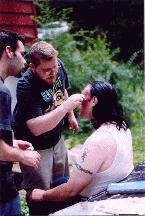
(Left to Right)
Special effects make-up artists Gene "Dead Kid" Mazza, right, and
Brian Spears apply make-up to
actor Don Deich while filming "Fairview Falls" in
Westchester County, N.Y. The make-up artists wanted Don Deich’s
face to
look like someone shoved the edge of an iron through it.
He promised me it wasn’t a snuff film. Right now I’m having my doubts.
Brian Spears and I and a bunch of other people I don’t know are standing in the
cramped living room
of a two-family house in Putnam Valley, N.Y.
It’s humid, face-melting weather. The air stinks with an odd mixture of latex,
wet carpet and body
odor.
There is clutter everywhere — books, magazine and tons of DVDs.
A burly dude in his 40s sits drunk on an Archie Bunker arm chair. He’s wearing a
wife-beater T-shirt.
He has jet black hair and a few mean-lookin’ tats crawling
up his arm.
If there was a white trash Olympics, this guy would bring home the gold.
Then, from a kitchen in the back of the house I can’t see because I’m wedged
between the front door
and a stair case, I hear a faint female voice:
“Everything’s fine, Daddy.”
It comes through as a whimper.
“Everything’s fine, Daddy,” she says again.
I’m creeped out. I feel like there’s a bug running up my arm. I turn to Spears.
He’s standing next to
me, looking bored, like a kid in church.
“You told me it’s not a snuff film,” I whisper.
“I wish,” he said, then smiled.
Welcome to the second day of shooting for “Fairview Falls,” a horror movie
filmed over the summer in
Westchester County, N.Y.
Here’s the plot, abbreviated. A group of kids in a small town gets wind of
ritual animal mutilations
happening on the edge of town. They set out to see
what’s up. People die. Secrets are revealed.
It’s the fourth movie for writer-director-producer Glen Baisley, who’s previous
low-budget horror films
include “The Tenement,” “Sins of the Father” and “The
Family Tree.”
Forget what you see on the Independent Film Channel — this is true independent
filmmaking.
Baisley shoots on digital video. He’s one of a thousand guys around the country
who picked up a
camera in the wake of “The Blair Witch Project” and declared
themselves filmmakers.
Baisley finances his movies out of pocket. He shoots them wherever and whenever
he can — he’s
been known to steal a shot or two.
Spears, meanwhile, is a make-up artist. Not the kind of make-up artist who puts
eyeliner on
actresses and lathers cover up on blemishes.
No, Spears makes things like rotting torsos, junkie track marks, gunshot wounds,
zombies, vampires
— anything ugly.
In other words, Spears gets paid to make people bleed.
It’s a lifelong passion for the 31-year-old Blind Melon fan. I should know. I
grew up two houses
away from the nut job.
When other kids in high school art classes were drawing sunflowers, Spears was
making clay molds
of Henrietta, the fat lady trapped in the basement in “Evil
Dead 2.”
After high school Spears got a full ride at the Art Institute of Pittsburgh.
There he rubbed shoulders
with Dennis Hopper at an art show, sold beer at Three
Rivers Stadium, sold plasma for drinking
money and lived with a guy who drank
cough medicine.
He’s done a lot of work for low budget horror flicks since graduating. Perhaps
you’ve seen “Midnight
Mass” or “The Adventures of Young Van Helsing?” He’s even
been featured a few times in “Fangoria”
magazine (the New York Times of the
horror movie world).
Two years ago Spears won an award at the New York City Horror Film Festival for
his work on “Flesh
for the Beast,” a movie that breaks records for excessive
gore and boob shots.
Enough background. Back to the weirdness at hand.
The drunk guy sitting in the chair from the top of this tale is aspiring actor
Don Deich. Later, I learn
he’s a magician. He does a trick where he
can make a door key move in his hand without touching it.
At the time of the interview, Deich was moving to Salem, Mass. because he saw a
shortage of
occult-related businesses there.
Baisley was filming a scene that day that implied an incestuous relationship
between Deich’s
character and his daughter. While he sits in the living room
drunk, she’s in the kitchen, planning his
death.
“There’s some incest going on,” Spears said, matter of factly. “Basically what
she’s going to do is
f*ck him up and then take him out.”
The death scene — which involved the daughter smashing Daddy’s head in with an
iron — was filmed
later in the day.
In the meantime, Spears and his make-up crew — including Gene “Dead Kid” Mazza
and Dana Elder,
a twenty something, rail-thin chain smoker who worked previously
on the popular indies “Wet Hot
American Summer” and “The Station Agent” — spent
most of the day standing around waiting to film
Deich’s gruesome death scene.
They smoked cigs, complained about being hungry, made fun of an actor who kept
professing his
love for George Bush and tortured Baisley, the writer-director.
The “quiet on the set” rule means you can’t talk as the crew shoots film. It’s a
concept lost on
Spears, who seemed to get a perverse joy from screwing up
Baisley’s shots.
Baisley, well over 6 feet tall and wearing a two-sided “Halloween” shirt, has a
bit of a temper.
He and the actors filmed inside the house while Spears and the make-up crew set
up shop —
make-up, brushes, latex used to make facial wounds — on a picnic table
in the back yard.
The walls of the house were paper thin.
Anything Spears said was picked up on Baisley’s camera — which pissed Baisley
off to no end.
I lost track of the number of times Baisley popped out the back door of the
house, shot Spears a
crazy look and told him to shut up.
Spears would laugh, say something horrible about Baisley’s sexual appetite, then
keep talking.
“I like messing with him,” Spears said. “It’s funny.”
The day began at 8 a.m. By noon, Baisley was ready to kill someone.
“We’re not going to finish the scene unless we have quiet!” he screamed at the
make up people
before slamming the back door of the house shut.
When Baisley was finally ready to film Deich’s death scene, he emerges with the
actor and explains
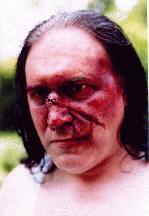
to Spears what he wants. Spears has to make Deich’s face look
like someone shoved the edge of an
iron through it.
“I need it to look like the iron came down right here and went across like this
— boom!"
“He got hit with the flat side of the iron right here,” Baisley tells Spears,
gesturing toward the actor’s
ear. “He goes down, she does a next bit of
dialogue, then BOOM! She hits him again and he’s out.”
Spears works quickly. Then he applies a flesh colored latex appliance to the
actor’s nose, making it
look broken.
“For the wound I’m using collodion, the same material used on Tom Berringer in
‘Platoon,’” Spears
explains. “It shrinks the skin slightly. For the broken nose,
I’m using mortician’s wax. Wax was huge
in the early days of film. We don’t have
much of a budget here.”
He sealed the face wound make-up with something called prosaid, a make-up
adhesive.
A few strokes of the brush for bruising and viola — Deich looks like the living
dead.
The whole process took Spears no more than two minutes. Thirty minutes later
Spears rigs an
actress’ arm to make it look like she slashed her wrists.
While Baisley looked like he wanted to punch Spears several times, Baisley said
they’re buddies.
“Sure I yell and scream a bit, but everybody ends up laughing at me,” Baisley
said.
The day ended around 3 p.m. or so. Baisley and his actors were heading to a
local high school
graduation. The plan was to plant two actors in the audience
and then film a drug deal. Baisley was
hoping no one would catch onto the fact
he was filming a movie.
The plan didn’t work, but the movie crew managed to stay out of jail.
To find out more about Spears, Baisley and their movies, visit
www.lightanddark.net.
The Blood, Sweat, Tears (and More Blood) of a Low Budget
Horror Actor
Written by Mike Lane
I recently finished acting
in a horror short by Light & Dark Productions called No Trespassing 2: No
Exit. I vividly remember sitting on a couch at the Inner Sanctum Haunted
House at the Canopus
Country club in Putnam Valley,
NY, getting ready for my death scene-an axe to my head.
During rehearsal, director
Glen Baisley explains the cue for the killer (Gene Mazza) to burst through
the
door and kill me. The cue will be a certain line that I say. I must have my
head in a marked
spot on the couch so Gene knows where to strike with the axe.
The “axe” is made with a balsa wood blade and a wooden handle. The fake weapon
will actually be hitting the back of the couch that I
am sitting on and not my
head. I also must not move my head. If I do, I will mess up the framing
of the
shot. Gene, as any good killer would, is wearing a gas mask. Unfortunately,
the gas mask
has an obstructed view.
Glen yells, “Action!” and
the scene begins. Gene bursts out of the door and wields his mighty axe.
Since
his viewing is obstructed he misses his mark and hits me square on the back of
my skull with
the unpredictably hard balsa wood. The blade goes flying off its
handle towards Glen. The back of
my head begins to sting and throb. After
apologies from Gene, the axe is repaired and Glen
eventually gets what he wants
after a few takes. During those takes I was nervous about the axe
hitting me
again but I couldn’t show it, because my character wasn’t feeling nervous. My
death
scene, however, is not yet finished.
Gene, who is also the makeup
effects artist, prepares for the next shot, which is the axe being
pulled out of
my head while blood runs down from the impact wound. I am proceeded to be
covered
in dyed corn syrup (the perfect blood FX) from the top of my head all
the way down to my chin. The
scene is filmed successfully but I will be needed
for another scene later … about two hours later.
Since I can’t walk around
the location drenched in fake blood for fear of staining everything I touch, I
do my best to wash the stuff off my face, chest, shirt and pants. The fake
blood is incredibly sticky
and messy. I wash my stained shirt with water from
Canopus’ rest room sink and hang it up in front
of a heater to dry. A few hours
later I change back into my wardrobe (which has become stiff and
crusty because
of the sticky corn syrup and intense heat) and Gene pours a fresh bottle of
blood all
over me again. My final scene is shot and I get to clean up and
relax. Soon after, I find out that I
have to play a masked character since the
original actor had to leave for work. As the masked
character, I have to stand
perfectly still and make pretend I’m a haunted house prop. That particular
shot
only took about fifteen minutes. Eleven hours after we started, the day is
wrapped, another
day for a low budget horror actor.
I started to seriously
pursue acting after graduating college almost five years ago. I always wanted
to be an actor and working behind a desk for a living was something that had
grown very
unappealing to me as graduation approached. I had acted sporadically
throughout elementary,
junior high and high school, putting on skits for other
students, and also performed, produced and
directed movies for my high school
film and TV classes as well.
In addition, I also appeared
in movies and skits made with a VHS camcorder for about four years.
These
movies and skits were mostly improvised. My friends and I made these movies for
fun. We
just started recording and tried to see where our improv would take
us. I now have hours of footage that I am honestly scared to watch (mostly
since I had a mullet in junior high and high school).
I have been fortunate enough
to stay busy acting-wise throughout the past five years working on
everything
from drama, to comedy, to horror, to “how to” videos. Horror, however, is one
of my
favorite genres in which to work. I grew up loving horror movies. One of
my favorite movies of all
time is the original Dawn of the Dead. I’ve
had lead, supporting and principal roles in over 60
projects that include
movies, theater, television, commercials and industrials. Twelve of those
projects have been horror related.
I enjoy horror movies not
only from a fan standpoint but from a business standpoint too. Most
horror fans
are very loyal. If they like a certain movie they will let everybody know about
it. Since
the fans are so loyal, horror movies are usually the easiest low
budget genre in which to land a
distribution deal. As a matter of fact, Light &
Dark’s latest movie, The Tenement (in which I have a
lead role), recently
landed a distribution deal with Brain Damage Films.
I have also met some great
people through horror. Horror fans, as evidenced by horror conventions,
are
almost like an extended family. Most of them are very nice people who are not
quick to judge
others by appearance even if they are full of tattoos, piercings
and made up to look like a demon on
crack. I’ve seen horror fans of all ages,
races, and creeds happily socializing with each other.
I have been shot, stabbed,
beaten with baseball bats, buried alive and eaten (all make believe of
course)
since I started acting in horror. The application, shooting and clean up of a
death scene
may take hours while the scene itself may last only a few seconds.
An actor having latex, fake
blood and other types of horror make-up applied to
him/herself cannot be impatient, claustrophobic,
allergic (very important) and
afraid to get messy. If the actor doesn’t mind getting a little dirty,
acting
in a horror movie is usually a very fun experience.
However, being a low budget
horror movie actor (as well as any type of low budget actor) is not
always
great. The pay, if any, is usually minimal. I have to work “survival jobs”
like bartending and
office temping to make ends meet. My acting career does not
allow me to work a regular job. My
survival jobs must be flexible enough so I
can take off at a moments’ notice in the event of a
last-minute audition or
acting gig.
Enduring huge cattle calls,
rejection, broken promises, working hard on a movie that ends up being
erased, a
movie that is never finished, never receiving a copy of a movie, a
producer/director who
doesn’t do anything with their movie once it is finished,
nepotism, politics and liars are just a few
setbacks of working in the low
budget world.
Remember when I wrote that
I’ve had lead, supporting, or principal roles in about 60 projects? Well,
out
of those 60 projects, I have received 20. My “payment” for some
of those projects is supposed
to be copies of the projects themselves. If not
for the learning experience, the time spent on these
debacles is completely
wasted. I only audition for paying gigs now, but I have also worked on
movies
that have promised to pay me but never have.
The crap-flavored icing on
the very smelly cake is that acting is extremely competitive. There are
only a
small percentage of actors who actually make a living only from acting.
A person who wants to be an
actor must deal with these (and many more) setbacks, learn from them
and move
on.
After my 11 hour shoot, I
take a quick nap and drive an hour and a half home to get ready for work
the
next morning. This survival job requires me to literally make thousands
of photo copies for the whole day. I am college graduate with a degree in
marketing. If I had decided to get a regular marketing job after college, I
would easily be making a lot more money than I am now. But I know wouldn’t be
happy. In fact, I would be miserable and full of regret, and that’s really no
way to live.
I can comfortably state that
I would rather spend another 11 hours on the No Trespassing 2: No Exit
set than work any permanent office job. So, when you see me on screen covered
in fake blood, and
playing dead with a shocked look on my face you will know
that on the inside I am smiling because
I’m doing what I want to do, which is
living my dream.
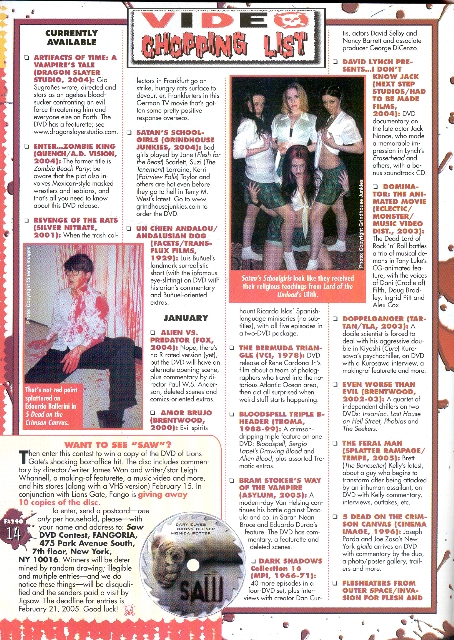
Satan's Schoolgirls (Grindhouse Junkies, 2004): Bad
girls played by Jane (Flesh for the Beast)
Scarlett, Suzi (The Tenement)
Lorraine, Kerri (Fairview Falls) Taylor and others are hot even before
they go
to hell in Terry M. West's latest. Go to
www.grindhousejunkies.com to
order the DVD.
Screaming Stoner Video: When did you first begin acting
and do you have a favorite film you've
been in?
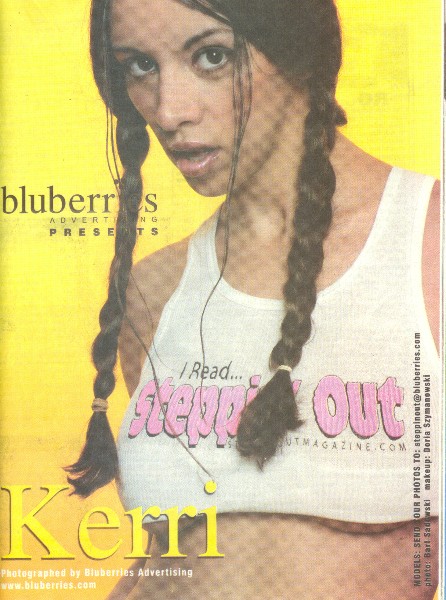
Kerri Taylor: I answered an ad in backstage for a TV show which never
worked out. The guy was
flaky but the photographer from the show Pat Mirucki was cool and introduced me to Bob Gonzo. I
did a few of his
movies then I met other filmmakers at the chiller conventions and started
doing
other stuff. My favorite films I have been in are probably
Satan's Schoolgirls, the Ghosts of Angela
Webb , Kill the Scream
Queen and the upcoming Fairview Falls with Light & Dark
Productions.
Screaming Stoner Video: Do you personally watch a lot of
independent movies?
Kerri Taylor: I watch some. I actually watched a few Seduction
Cinema's films. Some are good,
some are REALLY BAD. I did like
Screaming Dead and Bite Me.
Screaming Stoner Video: What's the best indie
film you've seen this year?
Kerri Taylor: Duh, Satan's Schoolgirls.
LOL and The Tenement was pretty good.